



What Does Pre-Plucked Really Mean? A Factory Guide to Natural Hairlines & Premax Wigs

Introduction
If you are new to the world of human hair wigs, the terminology can seem overwhelming. You will see terms such as 'pre-plucked', 'HD lace' and, more recently, 'PreMax' plastered across product descriptions. But are these just marketing buzzwords, or do they actually affect the appearance of the wig?
As a wig factory, we produce thousands of units every month. We know that the secret to achieving a natural-looking hairline isn't just the quality of the hair, but also the way the hairline is constructed.
In this guide, we take you behind the scenes to explain exactly what 'pre-plucked' means, clarify the difference between standard and customised units, and help you find the perfect beginner-friendly wig.

What is a Pre-Plucked Hairline?
Put simply, it means that the factory has removed excess hair from the front edge of the wig to mimic the growth pattern of natural human hair.
To understand why this is necessary, grab a mirror and take a close look at your own hairline. You will notice two distinct characteristics:
- Low density: The hair at the very front is much thinner and finer than in the middle of your head.
- Irregularity: Your hairline is not a perfectly straight line; it has natural peaks and troughs.
Standard, uncustomised wigs are often manufactured with high density right at the edge of the lace. While this maximises volume, it creates a harsh, solid border, which is often referred to in the industry as the 'helmet effect' or 'moon shape'.
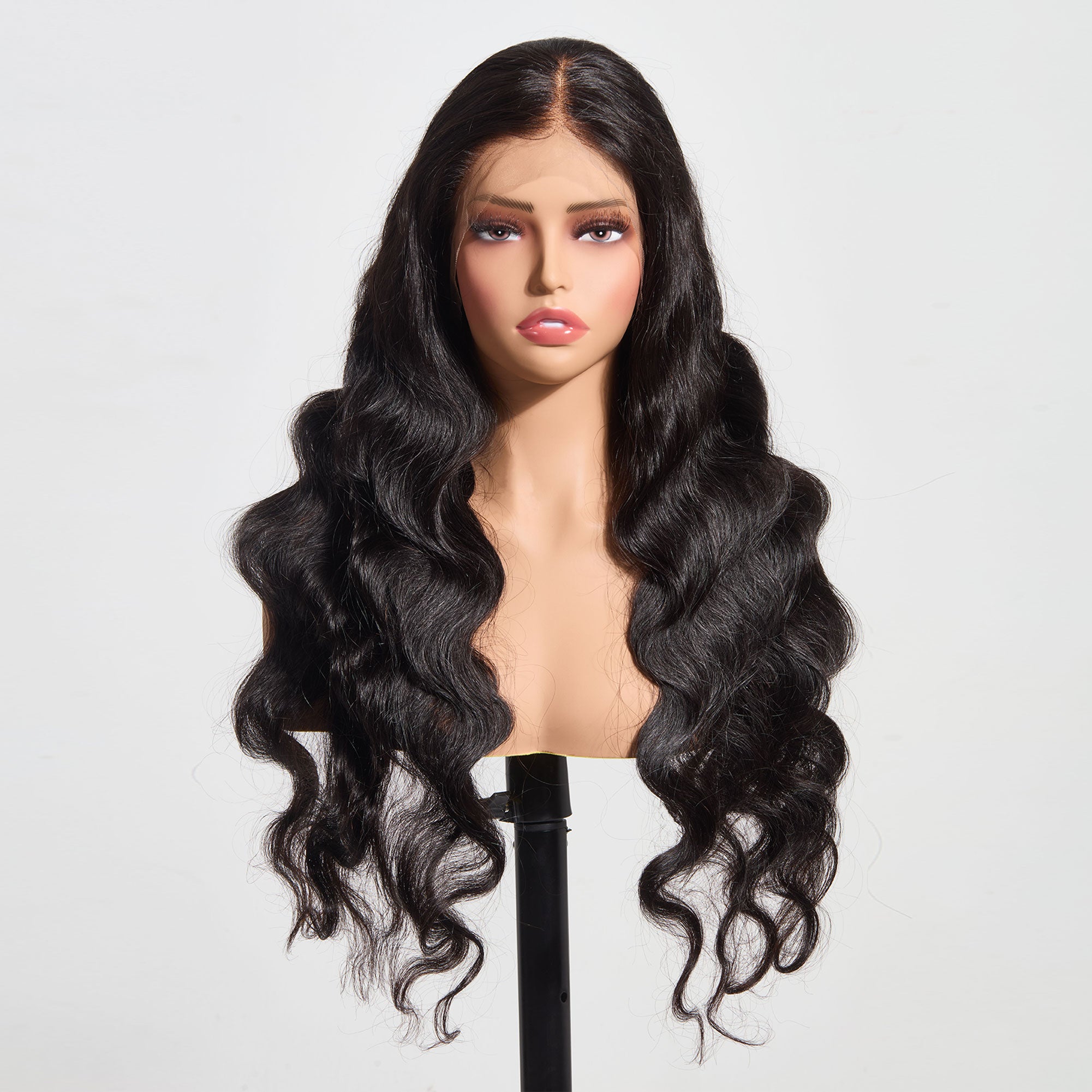
However, a pre-plucked lace wig undergoes a special customisation process. Our workers carefully thin out the hairline to ensure that the wig looks like natural hair growing from the scalp, rather than a dense cap sitting on your head.

Pre-Plucked vs. Unplucked: The Visual Difference
To understand why a pre-plucked unit is superior, it is helpful to look at the difference between a standard hairline and a customised hairline. The difference isn't just about the number of hairs; it's also about how light interacts with the lace and hair to create an illusion.
1. The unplucked look (standard)
An unplucked wig represents the 'raw' state of a manufactured unit.
- The look: It features a dense, straight hairline that runs from ear to ear. The density is 100% at the very edge of the lace, creating a hard shadow on the forehead.
- The work required: To achieve a more natural look, customers usually have to spend 30 to 60 minutes painstakingly plucking row by row with tweezers to thin it out. If done incorrectly, this can tear the lace.
2. The pre-plucked look (customised)
A pre-plucked wig is designed to replicate nature using a concept called gradual density. Rather than hitting the forehead with a wall of hair, the density builds up in zones:
- The Micro-Edge: The first few millimetres have the lowest density. This allows the lace to blend into the skin without leaving a visible 'line of demarcation'.
- The Transition: Moving back about half an inch, the hair transitions to a medium density.
- The Body: Finally, the hair reaches full density at the crown.
This gradual density is the secret to achieving a realistic look. It makes the hair appear as if it is growing slowly out of your scalp, rather than simply sitting on top of your head.
Inside The Factory: How We Create The Look
Many customers assume that all human hair wigs are mass-produced by machines alone. However, creating a high-end, undetectable hairline is largely an art form that requires handcrafting. To help you understand the value of your purchase, here is an overview of the techniques our workers use on the factory floor:
-
Precision Ventilation Technique: The foundation of a natural hairline starts with how the hair is tied to the lace. We use a specific ventilation technique involving single knots at the very front of the hairline (usually the first 13 mm).
- Why it matters: A single knot involves tying just one or two strands of hair to the lace grid. These knots are microscopic and much harder to detect than the durable double knots used at the back of the wig.
- Manual plucking: Once the hair is fully ventilated, the unit moves to the customisation station. Here, skilled craftsmen use tweezers to manually remove individual hairs. This process is not random: workers follow a specific pattern to create irregular 'peaks and valleys'. This deliberately breaks up the perfect symmetry of the ventilation and eliminates the artificial 'wall of hair' look.
- Baby Hair Creation: The plucking process naturally creates a perimeter of shorter, finer hairs. We style these specifically to be used as baby hair. These soft, wispy edges are essential for blending the lace with your skin and allow you to style the edges however you want for a soft, feminine finish.

Taking It Further: The Rise of Premax Wigs And Wear and Go (Ready-to-Wear) Wigs
As the wig industry evolves, customer demand has shifted from customisable to convenient. In the past, buying a wig meant that there was still work to be done at home.
Today, demand for wigs that are easy for beginners to use has led to the creation of a new standard: the Premax wig ('Pre-Everything' or wear and go wig).
While a standard pre-plucked wig focuses primarily on hairline density, a 'Premax' unit is the pinnacle of factory preparation. It is designed to be wear and go the moment you take it out of the box.
The following defines a true Premax unit in our factory:
- Deep plucking for clean parting: Standard plucking usually covers the first 0.5 inches of the hairline. A Premax wig, however, undergoes deep plucking. We pluck hair further back into the frontal area (up to five or six inches), creating a clean parting space with a distinct shape. This ensures the part looks wide and flat, mimicking a real scalp so you don't need to pluck it yourself.
- Bleached Knots: One of the biggest tell-tale signs that someone is wearing a wig are the tiny black dots (knots) where the hair is tied to the lace. In a Premax unit, these knots undergo a chemical bleaching process at the factory. This turns the knots from black to light brown or blonde, making them virtually invisible against the skin.
- Pre-cut lace: The lace trim is perhaps the most convenient feature. We use precision tools to cut off the excess lace on the forehead in a jagged or zigzag pattern. This technique provides a better blend than a straight scissor cut and spares you the anxiety of accidentally cutting off too much lace at home.
Conclusion
At our factory, we believe that the best wig is one that goes completely unnoticed. Achieving that seamless, undetectable look starts with the quality of the construction.
When you choose a high-quality pre-plucked lace wig, you're investing in expert craftsmanship, not just buying hair. The benefits are clear, whether you opt for a standard customised unit or a fully ready-to-wear Premax wig:
- You save time: skip the hours of tweezing and styling.
- You protect your investment: Avoid the risk of damaging your delicate HD lace by over-plucking it at home.
- You get professional results: Enjoy a natural-looking wig with perfect, gradual density straight away.
If you are a beginner looking for your first wig or a retailer looking to stock the most popular styles, be sure to check the hairline specifications first.
Ready to upgrade your style with a factory-customised look? Browse our exclusive collection of HD lace pre-plucked wigs today and experience the difference.